The Waiting is the Hardest Part

We live in a “right now” world. We want immediate results. We’re fans of instant gratification. We’re attracted to fast food, convenience, and anything that just takes one click of the mouse.

In fact, I don’t know anyone who is lining up to learn more about waiting and how to gain patience. We despise being put on hold, having to wait to see the doctor or checkout out at the store. And, let’s not forget the irritation of waiting on a train or being stuck in traffic. These examples reflect the sort of waiting that’s trivial and doesn’t necessarily keep us up at night.  So what about the other forms of waiting we encounter that are more challenging and often more serious and significant? Waiting for a job offer to do work your more passionate about. Waiting for a way to get out from underneath debt. Waiting for a meaningful relationship or marriage. Waiting for a healing from a broken relationship. Waiting for a child to complete your family. Or maybe you’re waiting on test results, a cure, a desire to live, a day where you are not judged or discriminated against. What if there is a plan and a purpose for our having to wait? What if God has something greater for each of us to gain in our waiting than frustration, worry, and anxiety?  

Waiting tends to be most difficult after we’ve stepped out in faith. We’ve taken action and we’re trusting God to show up and deliver only to discover that God often doesn’t operate at our pace. In the book, “If You Want to Walk on Water, You’ve Got to Get Out of the Boat,” author John Ortberg shares that waiting may be the hardest thing we are ever called to do in our lives. He explains that in the Bible, waiting is so closely tied to faith that the two words are often used interchangeably. So if God is all powerful, why does he make us wait? Because what God does in us while we wait is just as important as what it is we are waiting for.

We learn so many lessons in the waiting. We gain persistence, perseverance, and resilience. We grow in maturity and character. And we gain hope. Our faith strengthens and so does our trust. Ortberg makes an important point. Waiting isn’t just something we have to do while we’re in the process of getting closer to where we want to be. It’s a critical part of the process of becoming who God wants us to be. He goes on to explain that this form of waiting isn’t passive. Waiting on God is a daily decision to say “I will trust you and follow you. Even through my current circumstances are not anywhere close to where I want them to be right now, I am putting ALL of my trust and hope in you.” In many ways, it feels like a blind faith because we are putting our trust in what we cannot see. But we know that God sees things from a larger perspective and he is using all things and working them together for our good if we believe in him.  

Ortberg explains that all too often we want God’s resources, but we are not fans of his timing. In waiting, we must remain confident and expectant that God’s timing is perfect and that he knows what he is doing.  

The waiting really is the hardest part. It requires patience. I love Joyce Meyer’s definition of patience. She says, “patience is not the ability to wait, but how you act while you’re waiting.” We are called to patiently trust God in our waiting. We must put our confidence in him because we know that he is able. It’s important to recognize our own limitations. Ortberg shares that while we wait for something we learn to recognize that we are not in control. And we’re not just waiting around. We’re waiting on God. And we’re praying because prayer helps us to extinguish worry. And we know that God’s wisdom and his timing can be trusted.  

God honors our periods of waiting. He is in every detail of these difficult seasons we find ourselves in. So we keep putting one foot in front of the other knowing that whatever it is we’re waiting for is not more important than what happens to us while we’re waiting.  

How do you tend to respond to waiting? In what areas of your life is the waiting most difficult right now? What are some steps you can take to grow your patience?  

Doing vs. Being

Which one are you most comfortable with? For me it’s, hands down, the “doing.” While I have a sort of love-hate relationship with my never-ending “to do” list, I love the feeling of accomplishment when my pen or highlighter slashes through another item. The funny thing is though, for every task I cross off, there tends to be two or three new “to do’s” to replace that one. Can you relate? 

Here’s what I’m realizing and it’s not anything I’m proud to share. I think my “to do” list often gets the highest priority of my day. And when I’m caught up in all of the “doing” I can forget to focus much, if any, time at all on the “being” part. Being, in truth, has NEVER even made a cameo appearance on my “to do” list. And I believe it’s probably one of the most important things you and I can devote some serious thought to in order to be who it is we really want to be.  

To clarify, there are two kinds of “being.” There’s the “being” where we’re simply relaxing, hanging out, and having some downtime, maybe alone or in the company of others. Somehow, many of us have learned to associate this kind of “being” as less than, unimportant, etc. In fact, I don’t know about you, but I canI actually feel guilty or lazy, at times, for focusing on this kind of “being,”. I guess because I feel like I should probably be doing more. But “being” is also about our character and how we want to live this life we’ve been given. This sort of “being” can’t be easily measured and typically no one is handing out awards for those who are zeroing in on this kind of “being.” But maybe they should be because this sort of “being” has a greater and lasting impact don’t you think?  

We tend to sing praises to the ‘doers” because they are getting so much done. You’ll find them knee deep in activity much of the time. There the ones who are so proud to rattle off all that they’ve checked off their list. I know this because I am one of these people who delights in being asked, “Hoe was your day?” Just to be able to share all of my “doing.”. But what if we decided to let who we want to “be” dictate what we “do” on any given day instead of letting what we need to “do” drive who we are going to “be?” I’m preaching to myself right now. Trust me when say that I need to flip the switch and focus more on the “being” than the doing” starting, well, Immediately.  

I’m not trying to say that “doing” isn’t important. I believe it’s absolutely necessary. But I think it’s also crucial for you and I to consider who we want to “be” in the process. I’m certain we’ll make a greater impact on the lives of others if we place a greater focus on “being.”

We What would it feel like to be led by “being” today rather than your list of “to do’s?” What if we started our day by asking ourselves, “How do I want to feel at the end of the day and what will make me feel that way?” instead of “What do I want to get done by the end of the day?” How could this shift alone help you to be more of the friend, family member, spouse, partner, parent, or colleague that you really want to be?  

Everyone Has a Story

I’m so thankful for an email I received this morning from a friend who shared about an experience she had yesterday that could have unfolded quite differently if she hadn’t had a shift in her perspective and realized that everyone has a story.

It went something like this and I’m guessing you can relate. You get up and realize your morning isn’t exactly off to a great start. You find yourself dwelling on the negative. You rehearse the laundry list of everything that’s not right in your world, how you don’t measure up, how you’re not exactly where you want to be in your life, etc. You overhear someone talking about politics or really anything that’s a ‘hot button” topic for you and you’re less than impressed with their views. You find yourself irritated, to say the least. And let’s face it. You and I can be pretty quick to judge. In our minds we are placing all kinds of labels and names on this person. And more times than not, it’s often a person we don’t even know very well, if at all.

But what if you saw that same person you were quick to judge just minutes later with tears in their eyes. Trying to wrap their head around some pretty devastating news. That was the case with my friend. Would it change your perspective of this person? Would it open your heart up to express empathy to him or her? To be there to lend support?

I realize this isn’t an opportunity that often presents itself. To console someone we totally disagree with. But my friend had this opportunity and it’s a reminder to all of us that whether or not the situation would unfold in this way, there’s an important life lesson. Here’s what my friend said in her words not mine. “I was a fool to cast this person off because of her political beliefs. I hadn’t taken into consideration her life and what it meant for me to dismiss her intelligence because of her political views. It was a huge lesson learned about quick judgments and how you never know somebody’s life story.” My friend learned all of this by expressing empathy to the person who had just received heavy news. She consoled, asked questions, and thanked the woman she was quick to judge for the wisdom that she shared and she wished her well. Wow!!

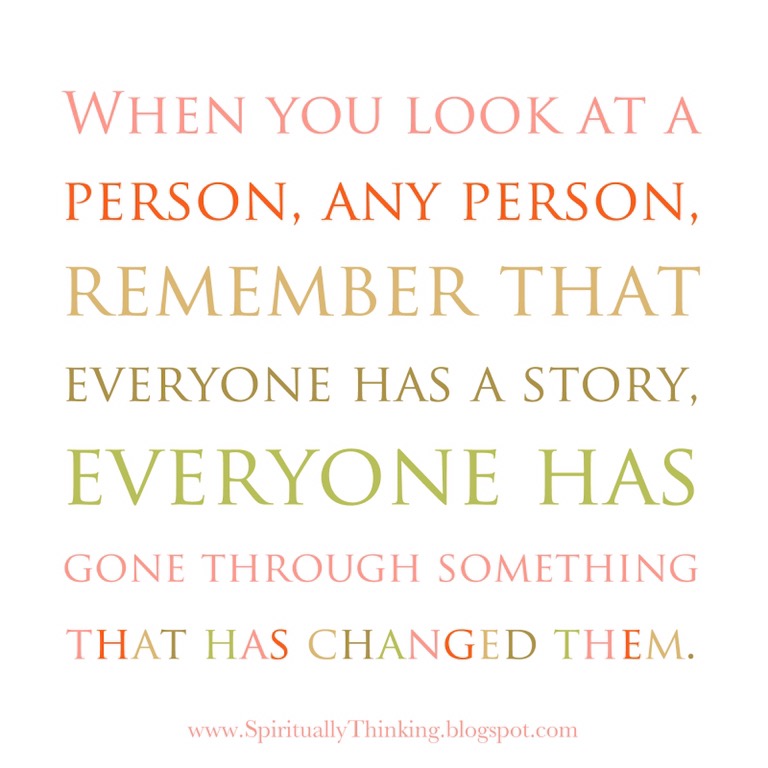
Every single person on the planet has a story. Everyone is going through something that is changing them. Or they’ve gone through something that has already changed them. The truth about someone may surprise us. And since we won’t always have the insight about what’s going on beneath the surface with someone, it’s safe to assume that they are battling something. Just like you and I.

What We Focus On We Find

What we focus on we find. Really think about that and ask yourself where your focus is much of the time. If you’re focused on your problems, you’ll find plenty more challenges ahead. If you’re focused on possibilities, you’ll find more opportunities that await you.  

If I’m honest with myself, sometimes I spend much more time thinking about and talking about what I don’t want rather than what I do want. If what we focus on we find, you and I aren’t not doing ourselves any favors with this type of thinking as our default.    When we focus on what we don’t want thoughts of fear, worry, and frustration become road blocks. When we think about what we do want, we tend to heighten our awareness and creativity. We get excited about all that’s possible and focus our thoughts, actions, and reactions on what truly matters. We get clearer about our goals and tend to make better decisions.  

Managing our thought life is so important. What we think about shapes the way we feel. And the way we feel impacts the way we act. If we are overcome with thoughts of negativity and despair, we can’t expect to produce good results.

So what steps can we take to begin thinking more about what we want instead of what we don’t want? First, we can recognize when we’re in a place of negative thinking and shift our focus. We can also write down what we don’t want since that seems to come so naturally to us and flip those statements around by restating them in terms of what we do want. We can be more mindful of what we’re feeding our minds through what we’re watching, listening to, reading, etc. because what’s on our minds eventually reveals itself in the way that we feel and what we do. I realize this is all easier said than done, but with practice It will become more natural and there’s no doubt in my mind that we’ll be pleased with the return on our investment.

Control 

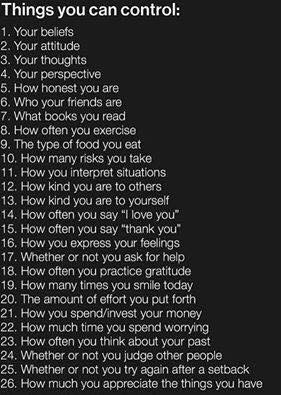
Oh how I long to be in control. Anyone else with me? I want things to be “just so.” I have thoughts, ideas, goals and dreams. Pretty good ones…I think. And when life doesn’t go according to plan, well, let’s just say I’m less than impressed, often disappointed and discouraged, and mostly crushed and deflated. Can you relate? Come on already! We put a lot of thought into these plans, right? Days, weeks, and in some cases, years. We’re at an all too familiar intersection AGAIN! You know, the one where we find ourselves in a head on collision with life circumstances we can’t control no matter how hard we try. No matter how grand our plan. Yes, there is pain at this crossroad, lessons to be learned, and resilience to be built. It’s here where you and I must remember to let go a little. Pray. Trust. Have faith that things will work out. Let life happen. Watch things unfold. And revisit what we can control.

Livin the Dream

Have you encountered this conversation before? It goes something like this. You ask the question, “How are you?” And the person you’re talking to responds, “I’m just livin the dream.”  

I think to myself, “Really?” And recently I’ve decided to express that thought in words. “Really? What’s going on? What’s your secret?” Just a few probing questions reveals what’s really beneath that statement, more than a touch of sarcasm. In fact, I’ve yet to come across someone who actually means what they’re saying when they say they’re “livin the dream.” 

Why is it that we’re so good at dreaming when we’re kids? A favorite questions to ask a child is what they want to do or be when they grow up. It’s fun to listen as a child’s imagination runs wild. As students approach high school graduation, the question is asked again, but this time with a little more pressure. “So what are your plans after high school? What college are you planning to attend? And what if you don’t know what’s next or you’re not even considering college? For those attending college, the question resurfaces as they close in on earning their degree. “What are your plans after graduation? Do you have a job lined up? “. The pressure from others, as well as the pressure we put on ourselves doesn’t mix well with continuing to dream. We start feeling like we need to meet a lot of other peoples’ expectations for our lives, not just our own.

So what do we do with all of this? Personally, I think we start a revolution. As adults, let’s commit to dreaming again no matter what season of life we’re currently in. Let’s not keep putting it off until we’re older, nearing retirement, or retired. Let’s get excited right now about what’s next for us. Let’s begin carving out more time to dream. Let’s initiate conversations with our spouses, partners, friends, and family members about our vision, dreams, passions, and purpose, and even our fears, and in doing so determine how we can best support each other in living it all out.

When someone asks us how we’re doing, what if we could answer with truth and certainty that we’re “livin the dream” with no hint of sarcasm? That we’re “livin the dream” because we’ve started allowing ourselves to dream again. That we made a decision to start living our best life now. That we’re choosing to enjoy every part of the journey. That we’re stepping out of our comfort zone and saying “yes” to things we didn’t think were possible. That we’re learning from the challenges and the setbacks. That we’re carving out time in the pockets of our day to start dreaming and making progress because we’ve realized that there’s never going to be a large chunk of time in our foreseeable future to make it all happen. That we discovered that the time to dream, plan and begin taking action to live out our dreams is now.

What about you? Are you willing to take a step toward the future that you want for yourself? What does that look like for you? Remember, there’s no age limit on dreaming. And there’s no size limit either, so dream big!  

Be Still

Be still. It’s not easy to do when our lives seem to move at such a rapid pace. The hours, days and weeks quickly become months and years. But there are blessings that come from simply being still. It reminds us who we are and whose we are. It’s in this stillness that I often receive wisdom and discernment from God and am reminded of my purpose, my passion, and my priorities. We tend to think that the greatest rewards only come from doing rather than being. And that’s not always the case. Is it difficult for you to carve out quiet time so that you can hear? What benefits have you discovered in choosing to be still?

Little Steps

It would be so much easier if there was just one GIANT step each one of us could take to reach a goal we set for ourselves, wouldn’t it? But that’s just not likely going to be the case. Here’s what I’m discovering:

-If a goal is really important, it’s going to take some time to reach it. We all have the time, right? Yes, we’re busy, but we all have the same 24 hours in a day.

-We tend to start out highly motivated and focused on achieving the goal because we’ve deemed it important.

-We can find ourselves easily frustrated by slow and steady progress, We think things should be happening much more quickly so we may decide take a giant step that’s too unrealistic. And in doing so, we may end up abandoning the goal altogether. Webtell ourselves we’re just not cut out for this or we lack the ________ to accomplish our goal. The blank could be time, money, skills, desire, willpower, persistence, etc.

-Small steps are meant to encourage us, NOT discourage us. They remind us that progress happens over time, that our commitment level grows stronger as we take the next step. Small steps build our courage and strengthen our faith. They remind us that we’re worth it.

-Along the way, we should expect to encounter a few detours or minor setbacks attempting to throw us off course. It’s just part of the process. And it builds persistence and perseverance within us if we keep pressing on toward our goal rather than giving in or giving up.

-There is no straight and linear path to achieving the goals we set for ourselves. We have to let go of perfection and prepare to get a little messy, but it will be worth it.

What’s holding you back from going after your goals? What are you telling yourself that’s preventing you from taking the next step? What if you really let yourself believe that now is as good a time as any to get started?

Are You Up for the Compliment Challenge?

Is accepting a compliment a breeze for you?  It’s definitely not one of my strong suits.  And I’ve started to ask myself why that’s the case.   I mean who doesn’t love a compliment about how they look, the outfit they’re wearing, or their work performance, right?  So why does it make us feel so uncomfortable?  I think for some of us (myself included), we struggle to believe the positive things people are saying about us.  We tell ourselves the person isn’t really being genuine.  Rather, they’re just trying to be nice.  That they don’t really mean what they said.  And we don’t like the focus or attention to be on us, even though it’s positive, so we quickly decide to dismiss the compliment giver’s opinion.  We’ll deny what they said and even end up putting ourselves down.  You know the drill.  A friend says, “I love your outfit.”  And you respond by saying, “It’s so old.  And it feels tight.  I really need to lose some weight.”  This kind of response only serves to downplay ourselves.  And it stands a pretty good chance of making the compliment giver feel bad, too.  We’ve all been there hanging in the balance as we extend a compliment that’s not well received.  It can feel awkward, to say the least, and you walk away feeling like you’re small act of kindness was rejected.  We may also think that accepting a compliment make us more humble or modest and we don’t want to come across as conceded.  But if we’re honest, most of us are eager to receive a compliment, especially from someone we admire and respect.

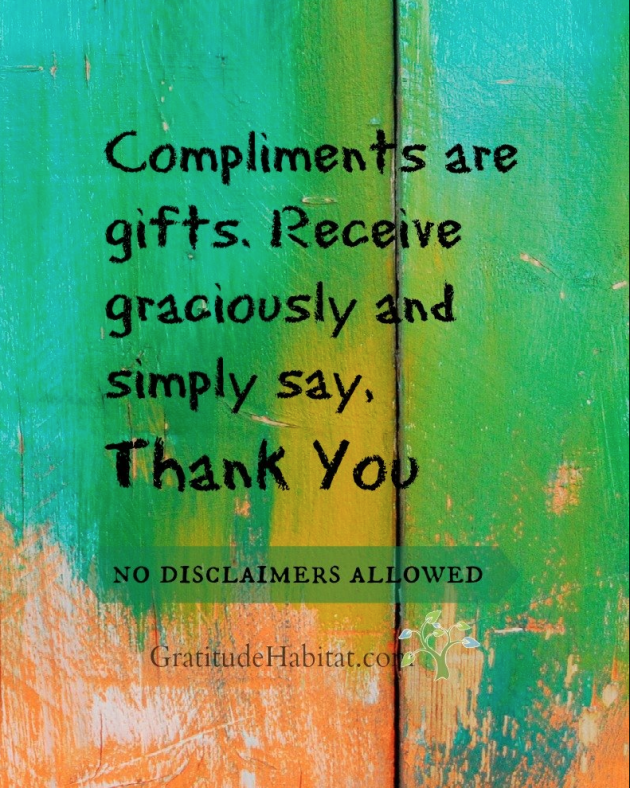
Graciously accepting a compliment can boost your confidence and improve your self esteem.  It also shows the person who extended the compliment that you appreciate them.  So for those of us who find this whole accepting compliment thing a real challenge, how can we break the cycle?  Where do you go from here?  I hate to say it, but I think it may be easier than we may think.  Maybe, just maybe, we pause and look the person in the eye and simply smile and say “thank you.” Or “thank you, I appreciate you’re kind words.” Nothing more.  Nothing less.  Are you willing to take the challenge?

Getting vs. Giving

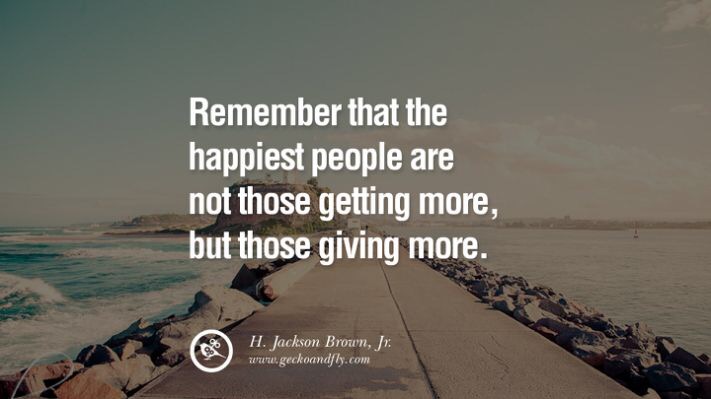
Anyone else wishing they would have learned this lesson much earlier in their life? The getting vs. the giving. And the idea that it really does feel better to give than to receive. As a parent of a two-year-old, I have questioned how I can begin instilling this value in my son, even at a young age.

I think the answer came to me last night when I wasn’t expecting it.  Ben and I volunteered, along with our life group, at a free medical clinic that our church hosts every week for those in the community who don’t have access to or cannot afford medical care. Our role was to serve a hot meal to those in attendance.  It was a humbling experience to say the least. What a blessing it was to serve the people and to meet some of the other volunteers who do this on a regular basis.  I had the opportunity to connect with a girl who literally blew me away. Her name was Grace and she was eight years old. One of the cool things about Grace was her huge heart for being there to help. She wasn’t asking what was in it for her. She was there to share her gifts and love people. I was curious how long Grace had been volunteering. And you can imagine my surprise when she said she has been doing this every week since she was four. What I found so attractive about Grace is that, at such a young age, she gets it. Like really gets it. She told me how much she looks forward to coming each week. She knows that her volunteer work matters and that the people she is serving matter, too. It was a beautiful thing to see unfold. She was also such an encourager to new volunteers and let them know what needed to be done and the best way to go about doing it.

In talking with Grace, I couldn’t help but think about her parents. It’s not happenstance that Grace understands the power in giving over getting. I learned that Gracie’s parents don’t just talk about the importance of volunteering. They walk their talk by giving away their time, their talents, and their love every week at the medical clinic. And they’ve been doing it since the medical clinic started four years ago. How easy would it have been for them to say “no?”  I mean they had a four-year-old at that time, right? Instead they said “yes” and in doing so they have instilled something so important in their daughter that I am betting will last for years to come.

I love that the same opportunity awaits me as a parent. If I want my son, Joe, to understand lessons like this one, I have to invite him into these experiences when it’s age-appropriate.

Whether you’re a parent or not, really makes no difference though. We can all lead by example and be the change that we want to see in this world. When is the last time you volunteered? How did it make you feel? What are you holding onto? What gifts has God given you that you sense he’s asking you to give away? If you already volunteer on a regular basis, I just want to thank you for the example that you’re setting for the rest of us. I hope you’ll encourage and invite others like me to step up on a regular basis and make a difference. Each and every one of us has something to offer that someone else needs.